BMW M3 (E30 - S14)
The Homologation Hero: High-Revving S14 Twin-Cam & Box-Flared Touring Car Royalty
Historical Significance & National Impact
Cultural Phenomenon & Bollywood Lore
The Box Flare Homologation Icon
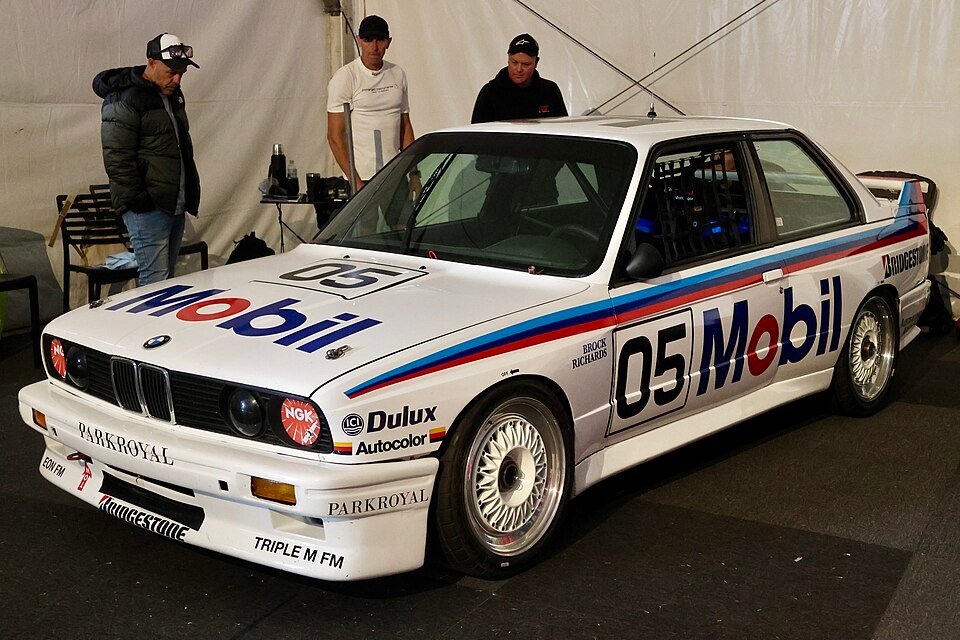
The E30 M3's widened boxed fender flares were not a cosmetic styling exercise; they were legally mandated to accommodate wide 10-inch racing slicks for DTM and European Touring Car Championship competition.
The Dog-Leg 1st Gear Racing Pattern
Equipped with a Getrag dog-leg manual transmission where 1st gear was down-and-left, placing 2nd and 3rd gear in a direct vertical line for rapid, seamless shifting during high-speed track racing.
The Golden Era of DTM Racing
Watching Roberto Ravaglia and Johnny Cecotto slide the E30 M3 through the corners of the Nürburgring and Hockenheim at 8,000 RPM created the global legend of BMW's 'Ultimate Driving Machine'.
Mechanical Anatomy & Driving Soul
The Paul Rosche-Designed S14 Engine
Featuring an iron M10 block combined with an aluminum cylinder head derived from the BMW M1 supercar's M88 engine, four individual throttle bodies, and dual overhead camshafts.
Aerodynamic C-Pillar & Raised Bootlid
BMW altered the standard E30's rear window angle and raised the steel bootlid by 40 mm, drastically reducing aerodynamic drag and increasing rear axle downforce at 200 km/h.
Getrag 265/5 Dog-Leg 5-Speed Manual
Close-ratio motorsport transmission with direct mechanical linkages and a 25% mechanical limited-slip differential for maximum corner-exit traction.
Production Milestones Timeline
E30 M3 Launches in Europe
Introduced to satisfy Group A homologation with 200 PS 2.3L S14 engine.
Evolution II Introduced
Lightweight glass, larger front spoiler, and power bumped to 220 PS.
Sport Evolution (EVO3)
Ultimate 2.5L engine (238 PS) with adjustable front splitter and rear wing, concluding in 1991.
Factory Engineering Blueprint
Restorer's Reality & Critical Rust Zones
Rust Hotspots
Valve clearance adjustment every 25,000 km using shims and timing chain tensioner upgrades preserves the high-revving S14 valvetrain.
Collector Index (2026)
Permanent blue-chip status among global automotive collectors.
Frequently Asked Questions
Why did BMW use a 4-cylinder engine in the E30 M3 instead of their famous inline-six?
Chief Engineer Paul Rosche specifically chose a 4-cylinder engine because a shorter crankshaft was significantly more rigid at sustained high RPMs (over 8,000 RPM in race trim) and reduced front-axle weight for sharper turn-in handling.
What is a 'dog-leg' gearbox on the E30 M3?
In a dog-leg gearbox, 1st gear is located down and to the left (where 2nd gear normally is). This placed 2nd and 3rd gears—and 4th and 5th gears—in direct vertical alignment for faster, smoother upshifts and downshifts on the racetrack.
How many E30 M3s were produced?
Between 1986 and 1991, BMW produced a total of 17,970 units across all coupe, convertible, and Evolution variants.
BMW M2 / M3
Modern 500+ bhp turbo power and screens, but lacks the sub-1200 kg analog dog-leg purity of the E30.