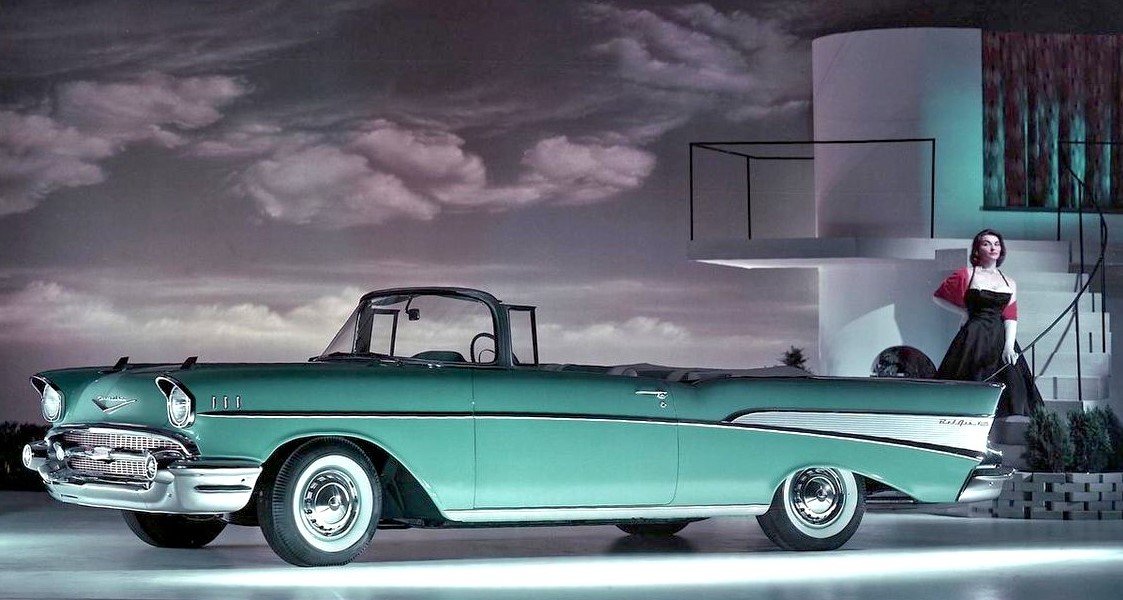
1957 Chevrolet Bel Air Sport Coupe
The Quintessential American Icon: Fuel-Injected 283 Small Block, Anodized Gold Trim & Chrome Tailfins
Historical Significance & National Impact
Cultural Phenomenon & Bollywood Lore
The Hidden Gas Cap
The fuel filler neck is invisibly hidden beneath the left rear chrome taillight assembly, which unlatches and pivots open on a hidden spring hinge.
The Tri-Five Golden Age
Between 1955 and 1957, Chevrolet produced over 4.7 million Tri-Five cars, cementing the platform as the most beloved classic hot rod canvas in world history.
Mechanical Anatomy & Driving Soul
Engineering Architecture
The 283ci small-block V8 featured lightweight thin-wall cast iron construction, overhead valves, hydraulic lifters, and became the blueprint for millions of Chevy engines produced over the next half-century.
Production Milestones Timeline
October Launch
Unveiled for the 1957 model year; over 166,000 top-of-the-line Bel Air Sport Coupes manufactured.
Nostalgia Boom
Becomes the premier collector car of the American nostalgic post-war revival.
Factory Engineering Blueprint
Restorer's Reality & Critical Rust Zones
Rust Hotspots
Stock single-reservoir brake master cylinder should be replaced with modern dual-reservoir for modern safety.
Collector Index (2026)
The gold standard of classic car hobbyists; virtually universally liquid and recognized across the globe.
Frequently Asked Questions
Where is the gas tank cap on a 1957 Chevy Bel Air?
The gas cap is ingeniously hidden behind the driver-side rear chrome fin taillight bezel, which swings open on a hidden hinge.
What does "Tri-Five" mean?
Tri-Five refers collectively to the 1955, 1956, and 1957 Chevrolet full-size cars, famous for debuting the small block V8 and shared chassis.
Chevrolet Corvette C8
Direct heir to Chevrolet small-block performance heritage.