Ferrari F40 (Tipo F120)
Enzo's Final Masterpiece: Twin-Turbo V8, Gated Dog-Leg & 201 MPH Raw Mechanical Terror
Historical Significance & National Impact
Cultural Phenomenon & Bollywood Lore
Enzo's Final Benediction
When Enzo Ferrari unveiled the F40 in Maranello in July 1987, he famously said: 'I expressed a wish to the engineers: build a car to be best in the world. And now the car is here.' He passed away thirteen months later.
The Poster Car of Every 80s Bedroom
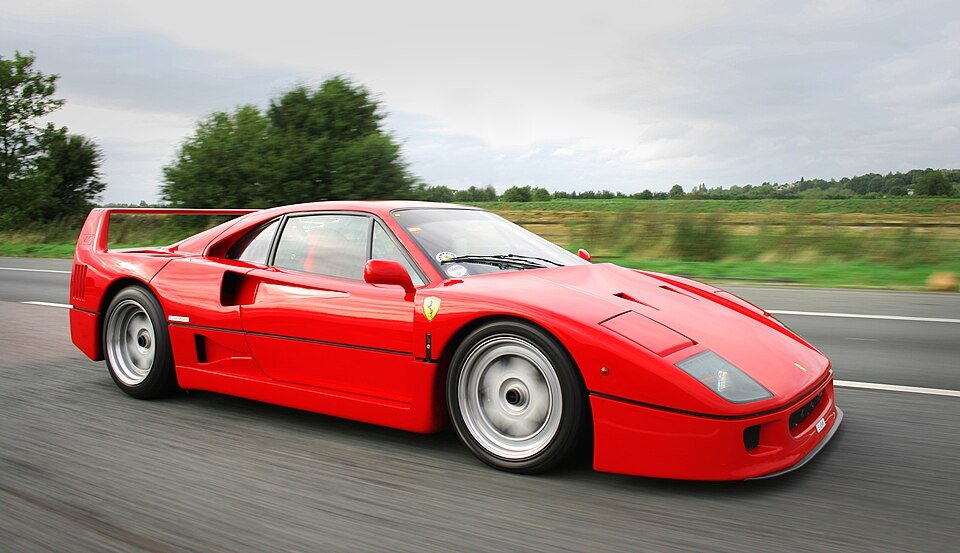
Alongside the Lamborghini Countach, the scarlet-red Ferrari F40 with its massive fixed rear wing and twin NACA bonnet ducts was the definitive poster car on the bedroom wall of every child who grew up in the late 1980s and 1990s.
Raw Carbon Weave & Green Glue
The F40 was so stripped-down that you could see the raw green bonding glue oozing between the Kevlar body panels, and the carbon-fiber weave was visible right through the thin layer of Rosso Corsa paint.
Mechanical Anatomy & Driving Soul
The 2.9L Tipo F120A Twin-Turbo V8
Flat-plane crankshaft, Nikasil-coated aluminum cylinder liners, dual overhead camshafts per bank, and twin water-cooled IHI turbochargers with Behr intercoolers producing 478 PS.
Kevlar, Nomex & Carbon-Fiber Bodywork
Designed by Pininfarina and constructed by ATR using composite autoclave technology, keeping total dry weight under 1,100 kg.
Zero Electronic Driver Aids
Features zero anti-lock brakes (ABS), zero power steering, zero traction control, and zero electronic stability management—demanding absolute driver skill and respect.
Production Milestones Timeline
Unveiling at Maranello
Enzo Ferrari reveals the F40 on July 21, 1987, to celebrate Ferrari's 40th anniversary.
US-Spec Model Introduced
Equipped with catalytic converters and revised front lip spoiler for North American delivery.
Production Concludes
Total production ends at 1,315 units, far surpassing the planned 400-unit run due to insatiable global demand.
Factory Engineering Blueprint
Restorer's Reality & Critical Rust Zones
Rust Hotspots
Fuel bladder replacement and turbo wastegate valve servicing are mandatory safety maintenance items.
Collector Index (2026)
Permanent blue-chip supercar royalty; widely considered the greatest turbocharged sports car ever built.
Frequently Asked Questions
Why is the Ferrari F40 considered the last true analog supercar?
Because it was engineered without power steering, anti-lock brakes (ABS), brake servo assistance, traction control, or electronic stability management, relying entirely on the driver's physical skill to control 478 turbocharged horsepower.
Did the Ferrari F40 break the 200 mph barrier?
Yes! The Ferrari F40 was the first production road car in global automotive history to achieve a verified top speed exceeding 200 mph, clocking an official 201.4 mph (324 km/h) in 1987.
How many Ferrari F40s were built?
Ferrari originally planned to produce only 400 units, but due to overwhelming global demand from collectors, total production reached 1,315 units between 1987 and 1992.
Ferrari SF90 Stradale / F80
Modern 1,000+ bhp hybrid all-wheel-drive supercars, but the F40 remains the untamed, analog mechanical dinosaur that will never be repeated.