Maruti Gypsy King (MG413W)
The Unbreakable Mountain Soldier: Indian Army Chariot & Raid De Himalaya Sovereign
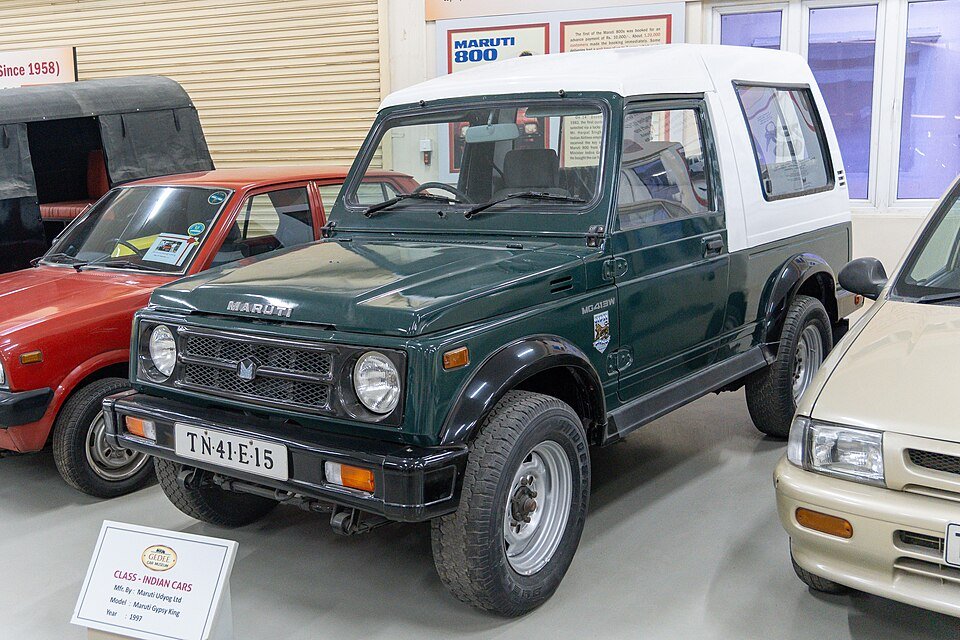
Historical Significance & National Impact
Cultural Phenomenon & Bollywood Lore
The Undisputed King of the Raid De Himalaya
In the brutal Raid De Himalaya, Desert Storm, and South India Rally, modified Gypsy Kings won more national titles than all other 4x4s combined. Tuned by legends like Northern Motorsport, these lightweight mountain goats blasted through 17,500-foot Khardung La passes, their G13BB engines screaming at 6,500 RPM while heavy diesels choked on thin oxygen.
The Safari Tiger Tracker
In Ranthambore, Jim Corbett, and Kaziranga, the dark green open-top Maruti Gypsy remains the sacred chariot of wildlife photography. Its silent petrol engine allowed forest guides to glide within yards of royal Bengal tigers without the clattering diesel vibration of traditional utility vehicles.
The VIP Convoy Outrider
No prime ministerial or presidential motorcade in India was complete without a fleet of dark blue Gypsy Kings. With folding canvas roofs and rear step plates, commandos from the Special Protection Group (SPG) hung from the side grab bars, ready to neutralize threats at a moment's notice.
Mechanical Anatomy & Driving Soul
The G13BB 16-Valve MPFi Engine
The 1.3L all-aluminum 4-cylinder engine was an engineering triumph: light, free-revving, and incredibly durable. Even when fed adulterated rural petrol at 14,000 feet, the Denso ECU and multi-point injection maintained clean combustion and crisp throttle response.
The Dual-Range Transfer Case (2H, 4H, N, 4L)
Direct mechanical linkage transfer box with a 2.268:1 low-range reduction ratio. Combined with manual Aisin locking front hubs, it delivers unbreakable 50:50 torque split between front and rear solid live axles.
Zero-Overhang Approach & Departure Geometry
With virtually non-existent front and rear body overhangs, the Gypsy boasted a 42-degree approach angle and a 35-degree departure angle, allowing it to crawl over dry riverbed boulders and deep trenches without scraping sheet metal.
Production Milestones Timeline
Launch of the MG410
Debuts with the 970cc F10A 4-cylinder petrol engine (45 PS) and narrow-track axles.
MG413W Wide-Track Introduced
Axle track widened by 90 mm for highway roll stability; upgraded to 1.3L carburetted 8V engine.
Launch of the Gypsy King MPFi
G13BB 16-valve MPFi engine added (81 PS); becomes the de facto tactical 4x4 of the Indian Armed Forces.
Civilian Production Ends
Discontinued for civilian sale due to modern crash safety and ABS mandates; special Army orders continued.
Factory Engineering Blueprint
Restorer's Reality & Critical Rust Zones
Rust Hotspots
Brittle leaf spring bushings and body floor rust. Adding aftermarket power steering and CFR (Composite Fiber Reinforced) leaf springs transforms it into a daily usable cruiser.
Collector Index (2026)
Steadily appreciating asset among off-road enthusiasts and safari tour operators across Rajasthan, Himachal, and Goa.
Frequently Asked Questions
Why was the Maruti Gypsy so bouncy on city roads?
The Gypsy was engineered for military payload and severe off-road durability using stiff, semi-elliptical leaf springs at all four corners. When driven empty without rear passenger or cargo weight, there is minimal spring deflection, transferring every road imperfection into the cabin.
Is the Maruti Gypsy 4x4 all the time?
No. The Gypsy uses a part-time 4WD system. For normal tarmac driving, it runs in 2WD (rear-wheel drive). 4H and 4L must only be engaged on loose surfaces (mud, sand, snow, gravel) to avoid drivetrain binding and axle damage.
Can you fit power steering in an older Maruti Gypsy?
Yes, aftermarket hydraulic and electronic power steering (EPS) kits—often adapted from Maruti Esteem or WagonR columns—are the most popular and recommended modifications for older Gypsys.
Maruti Suzuki Jimny 5-Door
Modern 5-door comfort, coil springs, and touchscreens, but lacks the raw, military-grade canvas utility of the Gypsy.