Datsun / Nissan 240Z (Fairlady Z - S30 - 1969 - 1974)
The Samurai Grand Tourer That Changed Japanese Motoring Forever
Historical Significance & National Impact
Cultural Phenomenon & Bollywood Lore
Mr. K & The Fairlady Rebellion
In Japan, Nissan corporate named the car the 'Fairlady Z' after the Broadway musical My Fair Lady. When Datsun USA president Yutaka Katayama saw the badge, he knew American sports car enthusiasts would never buy a car called Fairlady. Armed with a screwdriver and pliers on the dock in Los Angeles, Katayama personally pried the Fairlady badges off arriving cars and replaced them with '240Z' badges, creating an automotive marketing legend.
Wangan Midnight & The Devil Z (Akuma no Zto)
In Michiharu Kusunoki’s cult manga and anime Wangan Midnight, an S30 240Z tuned with a twin-turbocharged L28 engine painted in midnight blue becomes 'The Devil Z'—a possessed, supernatural road racer that tears down Tokyo’s Shuto Expressway at 300 km/h, challenging Porsche 911 'Blackbird' in high-speed street duels.
The Safari Rally Victory Against All Odds
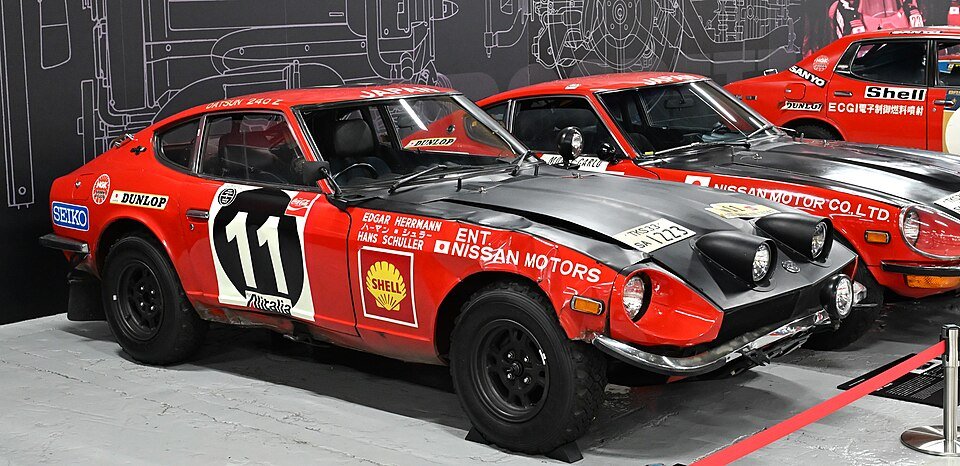
In 1971, Edgar Herrmann and Hans Schüller piloted their factory red-and-matte-black Datsun 240Z across 3,800 miles of punishing Kenyan wilderness to win the East African Safari Rally outright, solidifying the S30’s global reputation for unburstable structural integrity.
Mechanical Anatomy & Driving Soul
Block Architecture
Bulletproof L-series cast-iron block with 83.0mm bore and 73.7mm stroke; shared internal architecture with four-cylinder L16/L18 engines.
Cylinder Head
Aluminium crossflow cylinder head with wedge-shaped combustion chambers and chain-driven single overhead camshaft.
Fueling Carburettors
Twin Hitachi side-draft constant-velocity SU-type carburettors designed for simple synchronisation and reliable cold starts.
Production Milestones Timeline
World Debut & Market Introduction
S30 series built from October 1969 to 1978 (240Z transitioned to 2.6L 260Z in 1974, and 2.8L 280Z in 1975). Over 168,000 original 240Zs were produced.
Factory Engineering Blueprint
Restorer's Reality & Critical Rust Zones
Rust Hotspots
Early 'Series 1' cars (1970 with hatch vent grilles) command highest premiums; un-cut unmolested unibodies require diligent rust inspection around frame rails.
Collector Index (2026)
Steadily rising blue-chip status. Factory-original Series 1 240Z examples regularly fetch $60,000 to $120,000; the ultra-rare factory 432 Z432 (equipped with the Skyline GT-R S20 twin-cam 24V engine) exceeds $250,000.
Frequently Asked Questions
Why is it called the 240Z?
The "240" designates its 2.4-litre engine displacement (2,393 cc), while the "Z" was Nissan’s project code representing the ultimate, non-compromising sports car.
What is a Series 1 240Z?
Series 1 models were produced in 1970 with distinctive air exhaust vents on the rear hatch beneath the glass, a 240Z badge on the rear C-pillar, and a four-speed manual transmission.
Nissan Z (RZ34 Twin-Turbo 3.0L)
400 bhp twin-turbo VR30DDTT V6 with 6-speed manual and modern digital cockpit honoring the S30 silhouette.