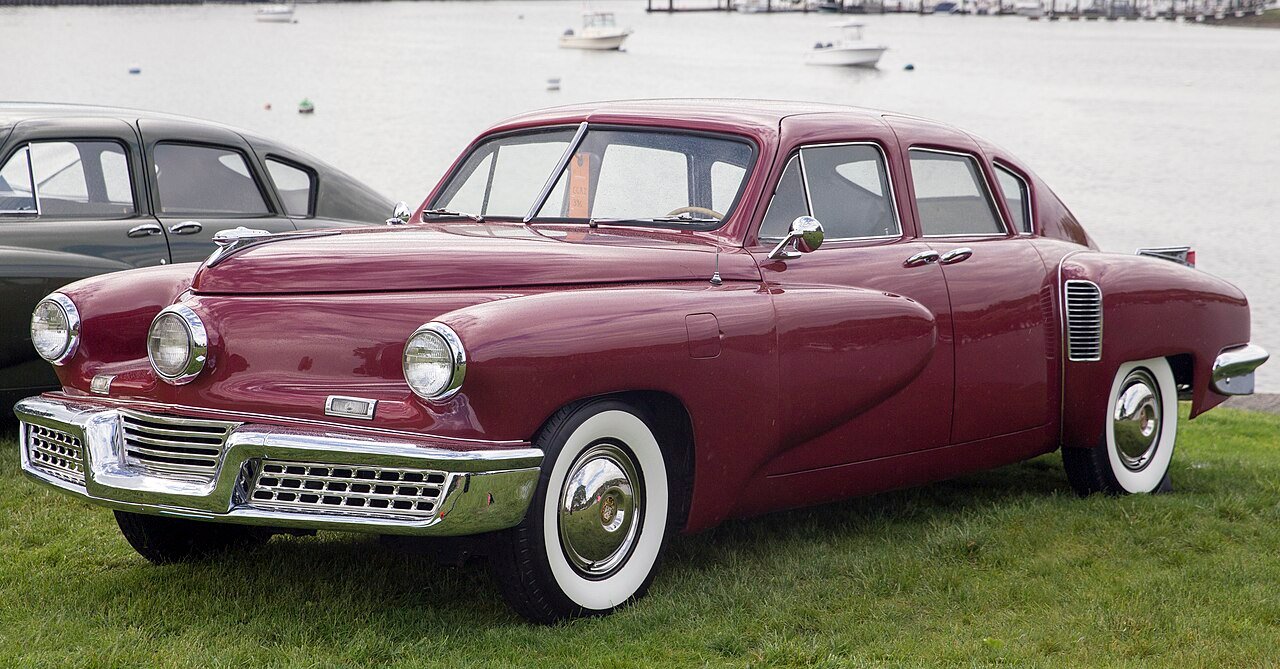
1948 Tucker 48 ("Torpedo")
The Cyclops Visionary: The Rear-Engined Safety Marvel with Directional Center Eye That Detroit Feared
Historical Significance & National Impact
Cultural Phenomenon & Bollywood Lore
The Cyclops Directional Headlight
Tucker’s central headlight was linked via mechanical cables to the steering box, turning up to 10 degrees with the steering wheel to illuminate dark curves before turning.
The Passenger Safety Chamber
In the event of an impending crash, front passengers were instructed to drop down into the padded empty footwell space beneath the dashboard for protection.
Mechanical Anatomy & Driving Soul
Engineering Architecture
Preston Tucker purchased Aircooled Motors and converted their Franklin air-cooled helicopter engine to water cooling, creating a bulletproof, high-torque flat-six that could propel the 4,200 lb sedan to 120 mph.
Production Milestones Timeline
Tin Goose Premiere
Unveiled before 3,000 cheering spectators at the Chicago plant.
SEC Acquittal & Factory Closure
Preston Tucker was acquitted of all fraud charges, but the company went bankrupt after completing 51 cars.
Factory Engineering Blueprint
Restorer's Reality & Critical Rust Zones
Rust Hotspots
The rubber torsion suspension tubes can dry-rot and settle over seven decades, requiring precision elastomer vulcanization.
Collector Index (2026)
One of the most famous, romantic, and tragic stories in all of American industrial history; every chassis is individually documented.
Frequently Asked Questions
How many Tucker cars survive today?
Of the original 51 cars built (including prototype 1000), 47 are accounted for in running or museum condition today.
Why did the center headlight turn?
The "Cyclops Eye" was connected to the steering linkage to illuminate corners and winding roads before the car entered the turn, decades before modern adaptive headlights.
Tesla Model S Plaid
Disruptive American independent automaker challenging established legacy carmakers.